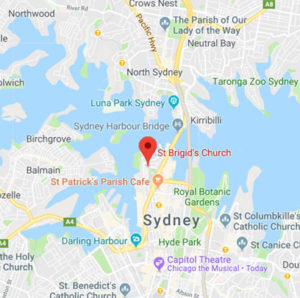
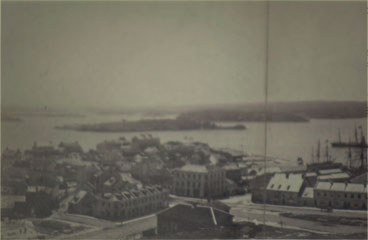
Situated in Kent Street, Millers Point, in Sydney’s historic Rocks precinct, St Brigid’s is the oldest surviving place of Catholic worship in Australia.
Governor Richard Bourke approved the site and building plan in 1833: “for a Roman Catholic School House, to be occasionally used as a Chapel”. The application for a land grant and school building was made on behalf of the Catholic community by Rev William B.Ullathorne OSB, Prefect Apostolic of Australia. This was two years before the arrival of Australia’s first bishop, John Bede Polding OSB.
Construction commenced in 1834, using “stone which is close at hand”. The single storey building was completed in April, 1835. The completed building was handed over in May, 1835, and was put into use immediately. A partition of folding doors divided the interior in half, providing separate class-rooms for the boys and girls. On Sundays, the school doubled as a chapel for Mass. When the school was officially inspected in 1839, 76 boys were under the charge of Mr Edward Hawkely, and Mrs Mary O’Brien was the teacher for 45 girls.
In March, 1843, the Christian Brothers took over responsibility for the school, and St Bridget’s (as the spelling was then) became an all-boys’ school under Brother Francis Larkin. A government inspection at that time gave high praise to the school, but after differences with Archbishop Polding over their right to recruit novices, the brothers withdrew from Sydney and returned to Ireland in 1847. Lay teachers again ran the school.
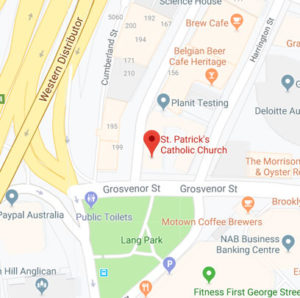
After the completion of St Patrick’s church in Grosvenor St., The Rocks, in 1844, St Bridget’s became incorporated in the newly-established parish centred around St Patrick’s. In 1868, the parish of St Patrick’s was entrusted to the Marist Fathers under Father Joseph Monnier SM, who also became responsible for St Bridget’s. Father Monnier built another school, confusingly known as St Bridget’s Hall, at 107 Kent Street, at the intersection with High Street.
A separate parish of St Bridget’s was created in 1874. For most of the five years of its existence, the parish priest was Father Pierre Jonghe (anglicised as Peter Young). However, many of the parishioners wished to continue being part of St Patrick’s parish, and in any case the new parish was too small to be viable in its own right. It was returned to the care of the Marist Fathers in 1880.
Sometime in the years 1865-75 an extension for a sanctuary and sacristy area was added to the eastern end of the building; and at the same time or a little later, a choir gallery was constructed at the western end of the building. In 1880 a finely decorated bronze bell, cast by Bardin Aine of Lyons in France, was installed on the northern wall of St Brigid’s. It is still in use today.
For about 20 years the Marist Fathers linked St Bridget’s with a third parish church they built in 1882, St Michael’s, in Cumberland Street, The Rocks. The St Bridget’s - St Michael’s combine was run as a separate sub-parish during these years, with its own resident Marist clergy living at St Michael’s. Fr Peter Piquet was in charge there in 1882, shortly after his arrival in Sydney.
The Sisters of St Joseph took charge of St Bridget’s school in 1880, along with St Bridget’s Hall. They lived in Cheshunt House, beside St Michael’s. There they also established a Providence, or orphanage, on the corner of Lower Fort Street, Cumberland Street, and George Street North. The Harbour View Hotel occupies the site today. The confusion of having two schools, both called St Bridget’s and both in Kent Street, was finally ended in 1888 with the sale of the St Bridget’s Hall property.
In 1900-01 the NSW government resumed the entire Rocks area at the time of a serious outbreak of bubonic plague in Sydney. While The Rocks was only moderately affected by the plague, the government used the climate of fear and anxiety to gain control of the area. The hidden agenda was a desire to demolish large pockets of slum dwellings in The Rocks and initiate a total scheme of urban reconstruction. St Michael’s church and St Joseph’s Providence were resumed and eventually demolished. On the other hand, exemptions were granted to St Patrick’s church, St Bridget’s church - school, and the nearby Anglican Garrison church.
From 1901 St Bridget’s was fully incorporated once again into St Patrick’s parish, and was serviced as a chapel of ease by the Marist priests at St Patrick’s. At the same time, with the departure of the Josephite sisters from the area, the Sisters of Mercy took charge of St Bridget’s school.
In 1933 an upper storey was added to St Bridget’s, and at that time the present spelling (St Brigid’s) came to be adopted. Father Daniel Hurley SM was the parish priest. The upper storey construction allowed the original ground floor building to be used exclusively as a chapel
From 1974 the Marist Sisters have ministered as pastoral assistants to the residents of Millers Point, based at St Brigid’s. Sr David Fitz Maurice was the first Marist Sister appointed to this work, followed in recent years by Sr Gemma Pearson.
St Brigid’s celebrated its sesquicentenary (150 years) in 1985. Only seven years later, in 1992, the school closed because of falling enrolments, but Mass continues to be held at St Brigid’s each Sunday.
St Brigid’s was closed for several months during 2002 to allow for interior restoration. Further restoration work took place in 2003 and an ongoing programme of maintenance and conservation will ensure that this historic chapel is preserved for future generations
Text: Peter McMurrich sm
In 1974 Fr Alan Connors, the Parish Priest of St Patrick’s, invited the Marist Sisters to be involved in Pastoral Care in the parish, and so it was that early that year Sr David Fitzmaurice began a ministry that was to continue for 13 years. While sister’s interests extended to the whole parish, the major part of her work was in the Millers Point – St Brigid’s area.
Sr. David was greatly loved by the people and made herself available to all. It was her dream that the local people in need of aged care would be able to find this close to home and friends. She was very involved therefore in the early days of preparing the groundwork for the setting up of Darling House which has become a beautiful and gracious aged care facility in the heart of the area.
Sr David was Darling House’s first patron. Sister visited people at home, and with the assistance of willing drivers, she also visited parishioners and local residents in nursing homes and hospitals all over Sydney.
Sr Joan Sheppard took up the ministry on Sr David’s retirement from her work in the parish in December 1986. Joan took up this ministry from 1987 to the end of 1989. During this time she had responsibility for the bookstall in St Patrick’s, but her particular strength was in her relationship with the people in the St Brigid’s / Millers Point area. For these three years she was very faithful to the regular visitation of parishioners, particularly to those who were alone, isolated, ill or bereaved. Joan had the wonderful gift of an attentive listener, and was able to be with people in the times of need. She also continued the practice of visitation of parishioners and local residents in hospitals and nursing homes.
In 1990, Sr Gemma Pearson began her ministry in a similar way with responsibility for the bookstall at St Patrick’s and pastoral care. Gemma’s relationship with the people of Millers Point was different in that her family had resided there since the early 1900s and she had lived within the parish until she entered the convent with the Marist sisters. ( She was and is affectionately known by many as ‘Marie’)
Gemma worked closely with the people as advocate for their needs and in 1994 felt that she could do this more effectively by living in their midst. And so the Marist Sisters gave permission for her to move into the area. Her High Street home became a place of welcome, open to parishioners and those in need – a warm attractive home, particularly because of the flowers. One resident said “The sisters live where the flowers are”. This insertion in the local scene enabled Gemma to respond to a need for a Breakfast Programme for children. With the support of a group of very willing helpers she established St Brigid’s Breakfast Club, not only meeting immediate needs but forging bonds that would last, with the children, the helpers and benefactors. Gemma also began a programme of teaching English as a second language, this was particularly helpful for a few parishioners who through their involvement in the classes began to see themselves as members of the community. For about 12 years Gemma taught Catechetics at Fort Street Primary School and prepared children for the Sacraments. Her relationship with the school from the very beginning was warm and welcoming and she loved the children.
Gemma acted as pastoral leader with St Brigid’s Church Committee in the different aspects af parish life eg liturgy, music, funerals, and celebratory gatherings which brought the St Brigid’s people into close community. In the wider local area Gemma was also appreciated and honoured for her work for which she received a Premier’s Award for care of the aged, and a Rotary Award, on the occasion of their Centenary, for her service to the community. In 2009, after almost 20 years of ministering to and with the people of St Brigid’s, Gemma said ‘goodbye’ to this work and ‘au revoir’ to the people whom she loved so much.